Place Value Addition Lesson Plan Materials Needed: Activity(Web-based, Java required), Whole-class computer display such as projector or smartboard, computers for at least every 2 students Rationale: Students in K-2, according to the new content standards, will need to be fluent in place value. This is something that our school will increase focus on as we move to the new standards. I chose this activity because it lends itself to relational understanding and exploration and because it fits with the following standards Core Content Standards:
|   Objective: |
Engagement
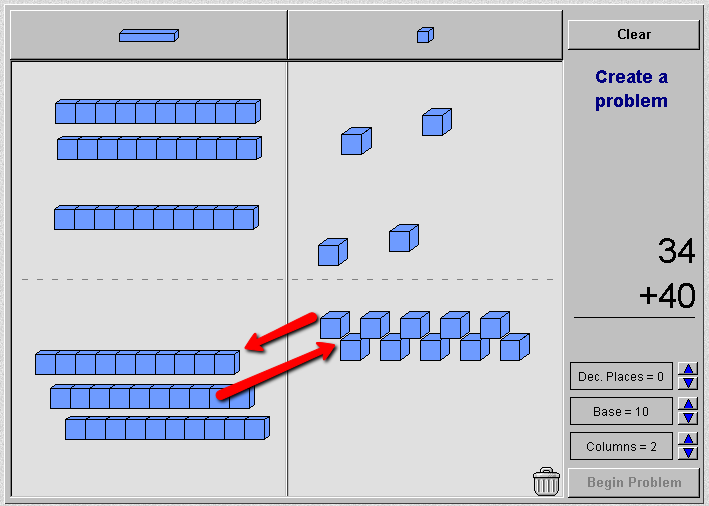
Show the class the game on a projector or IWB. After showing students the area which shows numbers on the right, ask if anyone thinks they can figure out how to make the addition problem say 42 + 31 (or any amount chosen by the teacher, but preferably requiring nonzero ones digits). This exploration will encourage students to figure out how the activity works. As different students try, discuss "what happened when we tried that?" and help guide students to know that they need to have tens and ones in the top to create the top number. They need to have tens and ones in the bottom to create the bottom number. Repeat with a 2nd or 3rd problem if necessary.
Partner Activity/Practice
Depending on the number of computers you have, students can access the activity in pairs. Partner 1 writes down a problem (such as 22+11) for Partner 2 to show and solve. Partners then switch roles and continue as time allows. The teacher uses this time to take note of any misconceptions that students have by moving from group to group asking questions such as:
"What number did you start with?"
"How did you create that number with 10s and 1s?"
"What did you notice when you were adding the numbers?"
"What happened when you dragged a 10 over to the 1s? Why?"
"Why is your answer __?"
*Optional, partner 1 creates with blocks while partner 2 works on the computer.
Discussion
Show what you know: students come up to projected computer to show what they did. The teacher asks similar questions to the ones for the practice time, this time of the whole class. Using a chosen method (such as chart paper or IWB file), the teacher publicly records mathematical observations about 10s and 1s.
Independent Reflection
Students can do a written exit slip or return to the computers to create a final addition statement, screen capture it, and post it to their individual blogs on the class blog. With their screen capture, they will include a response to the statement, "How I know that __ + __ = __" Students can then comment on other student's blog entries to continue the discussion.
