Which standard?
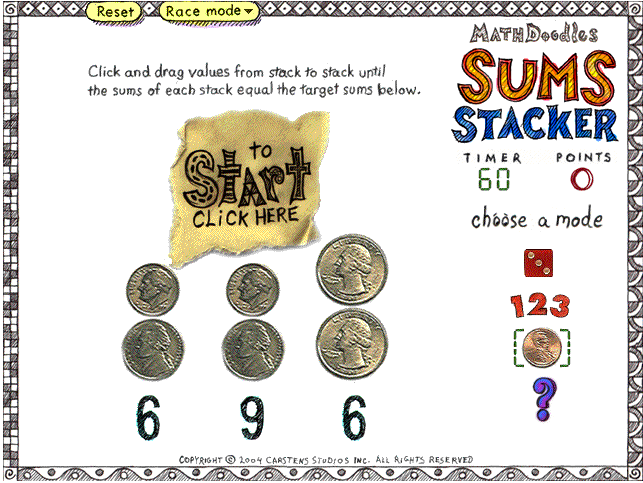
| The primary goal of this activity is for students to use their knowledge of coin counting (or number or dice adding, in additional modes) to create 3 given amounts of money. |
What mathematical content is being learned (or intended to be learned)? | Students are learning to more fluently count combinations of coins as they race the clock to match the sums. |
Is the focus on instrumental or relational understanding?
| To be successful, students will need knowledge of the coins and have some experience counting with them. They use problem-solving to move the coins to different places to create the correct sums. They will have to consider the value and sums of the coins several times in the course of just one round. |
What role does technology play? | The technology provides a fun way to practice coin counting, which can be rather repetitive as students learn to master it. It gives feedback for correct answers, encouraging correct counting. |
What instructional function(s) does the resource serve?
| This activity provides practice for students once they understand how to count coins and adds a problem-solving aspect to the practice. |
What kinds of representations of the mathematics are used?
| The real-world objects, coins, are used to create the appropriate sums of money. Students drag the coins from one sum to another until they have the correct answers in all three sums. |
