Which standard?
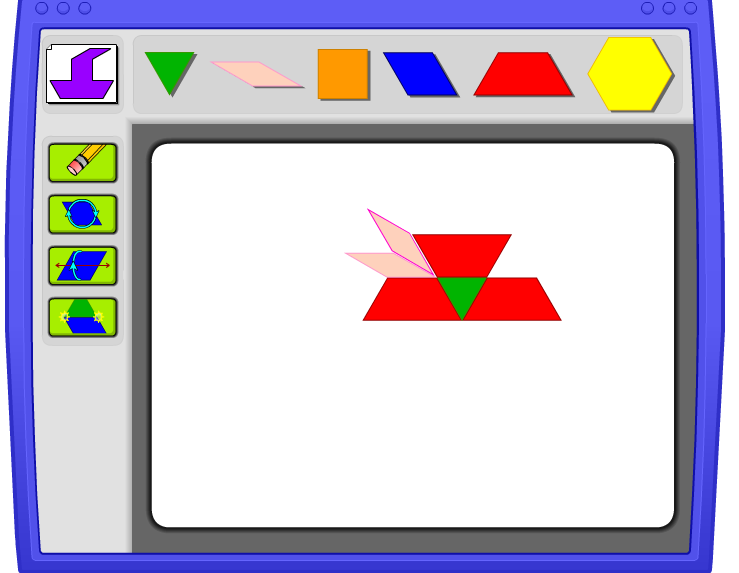
| The primary goal of this activity is for students to explore with the shapes. This is much like the explorations they would do with the physical blocks in a classroom. The activity also includes the option to try to fit the blocks in different templates. |
What mathematical content is being learned (or intended to be learned)? | Students develop their knowledge of shapes and properties as well as problem solving skills. |
Is the focus on instrumental or relational understanding?
| This activity is helpful to students because it takes an exploratory stance to using the shapes. The work surface doesn't provide just one right answer because it is an exploration. |
What role does technology play? | At first glance, the technology doesn't seem to afford students many benefits over using the physical blocks, but the opportunity to print or save (via screen capture) their work allows students to bring their work to discussions. |
What instructional function(s) does the resource serve?
| This activity provides explorations for students to examine the properties of blocks. They explore how they fit together in different patterns. |
What kinds of representations of the mathematics are used?
| These are images of the blocks used in classrooms. They can be manipulated via rotation or flipping just as the real blocks can. |
